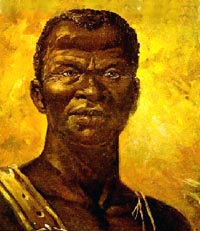
Zumbi was never a slave (nor a capoeirista); he was born free in Palmares in 1655. He was the army chief of the largest quilombo, « the Quilombo dos Palmares ». As a child he was handed over to Father Antônio Melo, who baptised him Francisco. He studied Portuguese, Latin and theology…
Even before the abolition of slavery, capoeiristas, alone or organised in maltas (gangs), were already disturbing and frightening society. The maltas were hired here and there in the conflicts between politicians of different factions…
From a very young age, Manuel Enrique, son of João Grosso and Maria Haifa, learned the secrets of street Capoeira from Mestre Alípio in Santo Amaro da Purificação, and was nicknamed « Besouro Mangangá » because of his agility and his knack for disappearing whenever he was needed…
Vicente Ferreira Pastinha (Mestre Pastinha) was born in 1889, the son of the Spaniard José Señor Pastinha and Doña Maria Eugenia Ferreira. His father was a shopkeeper who owned a small grocery in the historic centre of Salvador…
Manoel dos Reis Machado (1900-1974), the son of Luiz Cândido Machado and Maria Marinha do Bonfim, was born on 23 November 1900 in the “Engenho Velho” neighbourhood, Freguesia de Brotas, in Salvador da Bahia, Brazil. The nickname “Bimba” came from a bet between his mother and the midwife…
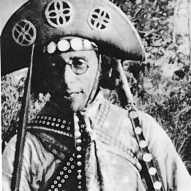
The Sertão, in the state of Pernambuco in the Nordeste, is poor in water and rich in cacti and dry vegetation; one of the oldest inhabited regions of Brazil, it was at that time also the least developed. Education there was rudimentary, and local society was run by the big landowners, who were at the same time the local politicians…
João Francisco dos Santos (1900-1976), a cabaret artist from Pernambuco, became famous under the stage name Madame Satã. Black, poor and homosexual, he lived on the margins of society, a regular in the heartland of bohemian life and carioca malandragem…
Mestre Waldemar was one of the most important practitioners of Capoeira Angola in the context of Capoeira’s rehabilitation. Waldemar’s fame as a capoeirista and capoeira master emerged in the 1940s. He established a great…
He started capoeira the way many others did. From a modest family, he had the opportunity to see Mestre Bimba, a Black giant with a piercing gaze and a broad smile, berimbau in hand, teaching what people at the time called: Capoeiragem…